Best Canadian S&P 500 ETFs (2026)
Three Canadian ETFs, one index, and a question most comparison articles won't answer: should you be buying the Canadian version at all?


VFV, ZSP, and XUS all track the S&P 500. They all charge a 0.09% MER (management expense ratio, the annual fee the fund takes from your returns). They all trade in CAD on the TSX. Over the past 5 years, performance differences between them are measured in fractions of a percent.
So which one should you buy? Honestly, any of them. The differences are small enough that you won't notice them in 10 years. But there are differences, and if you're the type who wants to know (you're reading this, so you probably are), here's the breakdown.
I've held Canadian-listed S&P 500 ETFs at different times for different reasons. These days I buy US-listed, but not for the reason you'd think. More on that later.
The 3 unhedged Canadian S&P 500 ETFs
All 3 of these give you the same thing. The full S&P 500, in Canadian dollars, with no currency hedging.
VFV (Vanguard S&P 500 Index ETF)
0.09% MER | $28B in assets under management (AUM) | Quarterly distributions
VFV is the biggest Canadian S&P 500 ETF by a wide margin. It's a wrapper. Vanguard Canada buys shares of VOO (the US-listed version) and packages them for Canadian investors in CAD. At $28 billion in assets, it's the default choice for a reason.
Liquidity is solid with roughly 220,000 shares trading daily. If you don't want to overthink this, VFV is a perfectly good answer.
ZSP (BMO S&P 500 Index ETF)
0.09% MER | $21B AUM | Quarterly distributions
ZSP takes a different approach. Instead of holding a US ETF underneath, BMO buys all 500 stocks directly. Same index, same MER, different plumbing.
The practical difference for you is basically zero, but ZSP does have the best liquidity of the 3. Over 1 million shares trade daily with a typical spread of about $0.01. If you're buying larger positions, that tighter spread adds up.
XUS (iShares Core S&P 500 Index ETF)
0.09% MER | $10B AUM | Semi-annual distributions
XUS is BlackRock's unhedged offering. Like VFV, it's a wrapper (holds IVV, the US-listed iShares version). It's the smallest of the 3 at $10 billion, which is still plenty liquid for any retail investor. The one quirk is that XUS only pays distributions twice a year instead of quarterly. That won't matter for most people, but it's there.
How to pick between them
This decision matters less than you think.
Same MER. Same index. Nearly identical performance. I've seen people spend hours comparing these 3 when the difference over a decade is a rounding error.
If you want a framework, ZSP has the best liquidity and tightest spreads. VFV has the largest asset base and the most institutional backing. XUS is fine but doesn't win any category.
Pick whichever your broker offers commission-free (most Canadian brokers now offer all 3 for free) and move on to the decisions that actually matter. Which account to hold it in. How much to contribute.
I covered the account question in RRSP vs TFSA for US investing if you're still sorting that out.
What about hedged ETFs?
You'll also see VSP and XSP when you're shopping for Canadian S&P 500 ETFs. These are the currency-hedged versions of VFV and XUS.
Hedging means the fund uses forward contracts to cancel out movements in the CAD/USD exchange rate. If the US dollar rises 5% against the loonie, an unhedged ETF captures that gain. A hedged ETF doesn't. The reverse is also true. If the loonie strengthens, the hedged version protects you.
That sounds reasonable in theory. In practice, hedging costs money (the forward contracts aren't free), and you're paying for protection against a scenario that hasn't played out over any meaningful stretch in recent history.
A decade of hedged vs unhedged
Here's what actually happened. $10,000 invested about 10 years ago:
VFV (unhedged): ~$35,000
VSP (hedged): ~$29,000
VOO (US-listed): ~$35,000 when converted back to CAD
That's about $6,000 left on the table by hedging. On a $10,000 investment. The chart below shows all 3 side by side.
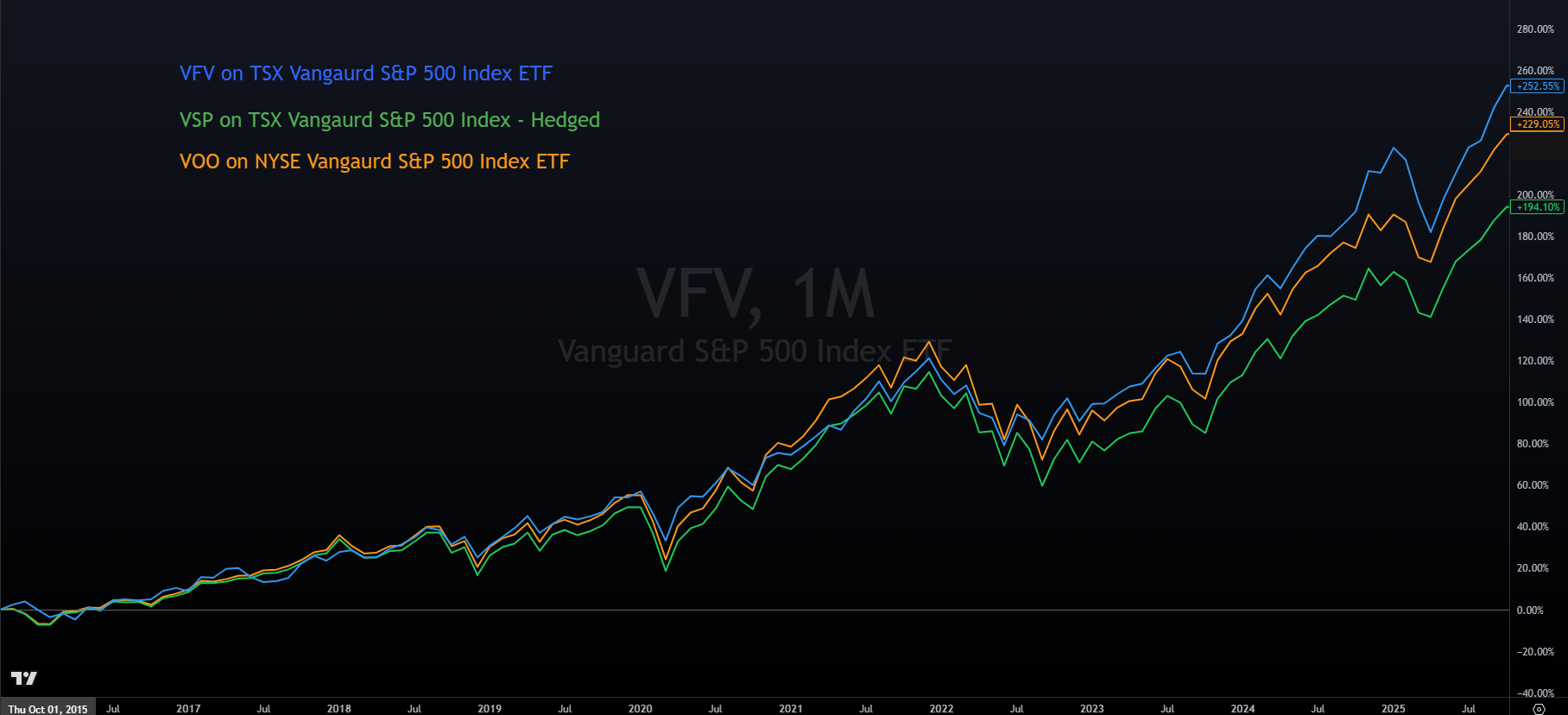
The worst year for the comparison was 2024. VFV returned about 35%, VSP returned about 24%. The hedged version didn't just underperform. It capped the upside by 11 percentage points in a single year.
There were windows where hedging helped. 2017, when the loonie had a strong run, is the main one. But those windows were short, and they didn't come close to offsetting the cumulative drag.
Here's how I think about it. You're investing in the S&P 500 because it's American. It's 500 of the biggest US companies, priced in US dollars, generating revenue in US dollars.
The currency exposure isn't a bug. It's part of what you're buying. Hedging it out means you're paying to remove the thing you came for.
If you have a strong conviction that the Canadian dollar is about to strengthen significantly, hedging makes sense. But that's a currency bet, and most people buying index ETFs aren't trying to make currency bets. For long-term holders, unhedged has been the right call. It's not close.
Why I go straight to the US listing
I'll be upfront. If all you want is S&P 500 exposure, a Canadian-listed ETF does the job. VFV or ZSP will get you there with minimal friction and you won't lose sleep over the result. The MER savings from buying the US-listed version (0.03% vs 0.09%) works out to about $30 a year on a $50,000 position. That's not a reason to restructure your accounts.
The reason I buy US-listed is bigger than the MER. I want direct access to US markets. Individual large caps, options on the MAG 7, more active trading when I see an opportunity. Once you're set up for that (USD in your account, a broker that handles US markets well, a reliable way to convert currency), buying VOO instead of VFV is just common sense. You're already there.
If you're heading in that direction, here's the quick breakdown on the US-listed S&P 500 ETFs. VOO (Vanguard), IVV (iShares), and SPY (SPDR) all track the same index. VOO and IVV both charge 0.03% MER. SPY charges 0.0945% because of its older fund structure, which also creates minor cash drag on returns. So SPY is out for buy-and-hold investors.
Between VOO and IVV, the performance is virtually identical. VOO has the edge on assets: $1.5 trillion vs $750 billion. Both have near-zero spreads and more liquidity than you'll ever need. I go with VOO.
The catch is you need US dollars. Your broker's default exchange rate is probably terrible (1.5-2.5% spread at most Canadian banks). That's where Norbert's Gambit comes in. It's the cheapest way to convert currency, and it's not as complicated as it sounds.
So the honest answer is this. If you're buying an S&P 500 ETF and calling it a day, stay Canadian-listed. VFV or ZSP. Done. But if you're the type who wants to go further into US markets (and that's what this site is about), get your USD setup sorted and buy VOO on the way in.
The bottom line
VFV, ZSP, and XUS all get the job done. Pick one and start. Don't hedge unless you have a specific reason to (and "it sounds safer" isn't one). If you eventually want direct access to US markets for individual stocks or options, get set up in USD and buy VOO on the way in. But for S&P 500 exposure on its own, the Canadian version is all you need.