The Final Boss IPO: How to Buy SpaceX Stock in Canada
$1.75 trillion. 30% retail allocation. RBC reportedly in the syndicate. The final boss of IPOs is here, and Canadians might actually have a way in this time.


SpaceX has reportedly filed for its IPO. $1.75 trillion valuation. $50 to $75 billion raise. If that holds, it's the largest public offering in history, and it's not even close.
Saudi Aramco raised $29 billion in 2019. SpaceX would more than double it.
Bloomberg, CNBC, Reuters, and the Wall Street Journal all reported the confidential filing on April 1, citing sources familiar with the deal. SpaceX hasn't confirmed it publicly. That's normal for a confidential S-1. The company doesn't announce it. The bankers leak it.
The codename is reportedly "Project Apex." Expected listing window is June 2026.
And for the first time in a long time, Canadians might not be locked out. RBC is reportedly one of 21 banks on the syndicate, managing Canadian retail orders. That almost never happens with US mega-IPOs.
I've been waiting for this one for years. It's looking very real.
The final boss just filed
Musk doesn't IPO companies on a whim. He did the same thing with Tesla. Waited until the business was cash-flow positive, dominant in its market, and undeniable. Then he opened the doors.
Starlink crossed that threshold. 9.2 million subscribers. Over $10 billion in revenue. Projected to hit $24 billion in 2026.
Cash-flow positive with a global monopoly on low-latency satellite internet. The numbers don't just justify a listing. They demand one.
But here's the part a lot of people missed. This isn't a Starlink IPO.
In February 2026, SpaceX completed an all-stock merger with xAI to create what they're calling "Orbital AI Data Centers." So when you buy SpaceX stock, you're buying the rockets, the satellite internet, AND an AI infrastructure play. All in one ticker.
Read that again. Rockets. Internet. AI. One stock.
The liquidity cycle explains the timing. Early VC investors want exits. Thousands of employees are sitting on stock options they can't sell. And the next growth phase (Starship at scale, direct-to-cell global rollout) needs serious capital.
This isn't Musk cashing out. This is Musk fuelling what comes next.
One ticker, every hot market
Most IPOs fit neatly into a sector. Tech company. Biotech. Fintech. SpaceX doesn't fit into any of them because it touches all of them. At once.
Space and rockets
SpaceX builds the rockets that launch its own product. Falcon 9 carries Starlink satellites to orbit. Starship will carry them cheaper, faster, and in bigger batches.
There's no middleman. They build it, launch it, and sell it. That closed-loop vertical integration is why the margins are potentially absurd.
And the competition can't keep up. SpaceX launched more rockets in 2023 and 2024 than the rest of the world combined. They build satellites like iPhones on an assembly line. Thousands per year.
Competitors build dozens. And they still throw their rockets away after a single flight. SpaceX lands theirs and flies them again.
The moat here is 3 things stacked on top of each other. Launch cost (10x cheaper). Manufacturing scale (orders of magnitude more satellites). Launch cadence (more than every other country on Earth combined).
Nobody has all 3. Nobody is close.
If Starship works at full scale, the cost to put anything in orbit drops by another 100x. Asteroid mining. Lunar bases. Mars missions. That stuff stops being science fiction and starts showing up in financial projections.
It's the part of the bull case that makes $1.75 trillion feel less crazy.
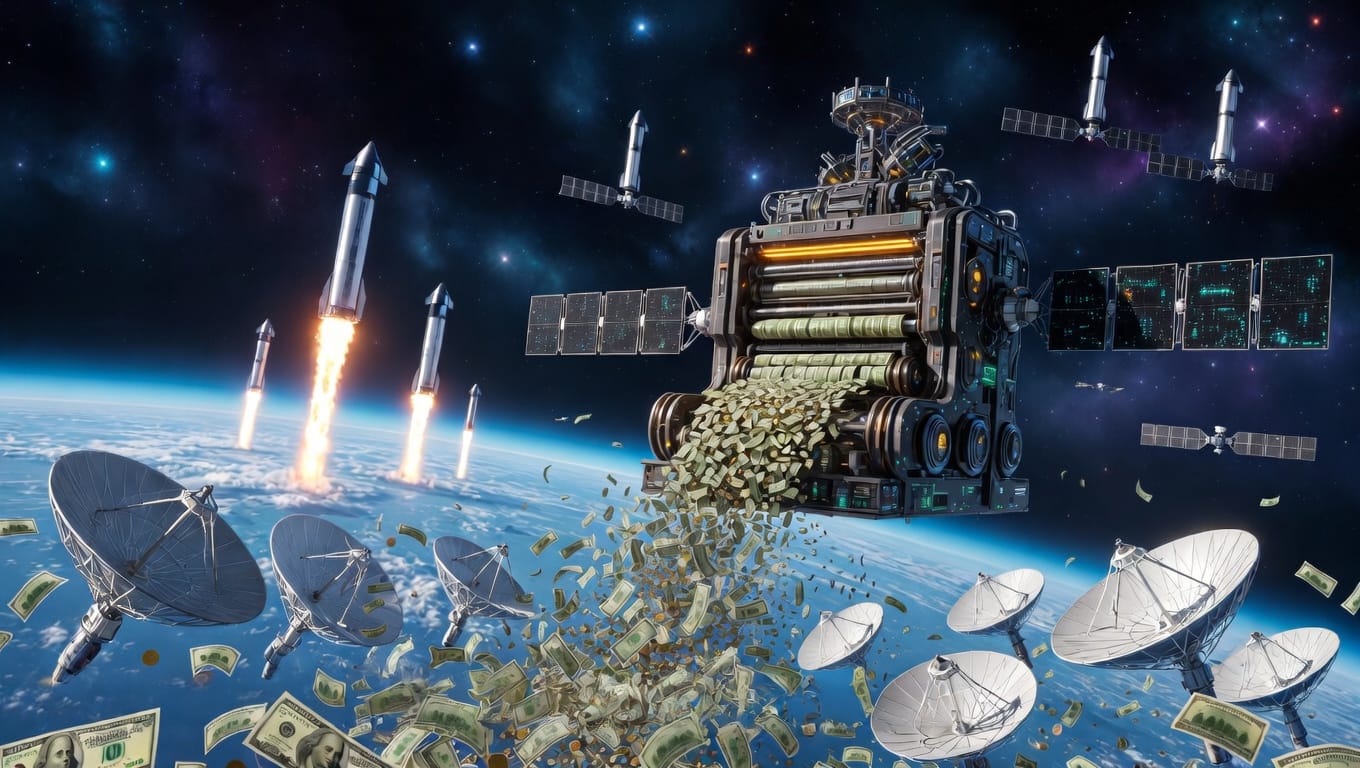
Starlink (the money printer in the sky)
Starlink is the first internet provider in history whose entire infrastructure is literally orbiting the Earth.
9.2 million subscribers paying $90 to $120 per month. Over $10 billion in annual revenue. Projected $24 billion for 2026.
And it's a subscription business. Recurring, global, and growing every quarter. Think of it as the SaaS play of the space world. Sticky customers, expanding TAM, and functionally no competition.
At $1.75 trillion, SpaceX would instantly join Apple, Microsoft, and Nvidia in the trillion-dollar club. On day one. Let that sink in.
The AI angle (xAI merger)
The February merger wasn't random. "Orbital AI Data Centers" is SpaceX positioning satellite infrastructure as AI compute capacity. And right now, anything with AI in the pitch deck gets a premium multiple. SpaceX just baked that into its valuation permanently.
Brilliant or reckless? Depends who you ask. I'll get to the risk side later.
Mobility internet (the sleeper nobody talks about)
Rural broadband is the Starlink story everyone knows. But the revenue layer that might actually justify the valuation is mobility.
Starlink now powers in-flight Wi-Fi on United Airlines. It runs the internet on Royal Caribbean cruise ships. It connects cargo shipping fleets and military operations.
Each commercial aircraft is a $150K to $500K annual service contract. Each cruise ship is more.
This is massive B2B recurring revenue and almost nobody in the IPO coverage is talking about it. They should be.
Direct-to-cell (the craziest growth vector)
This is the one that changes the TAM math entirely.
Starlink satellites can now connect directly to smartphones. No dish, no terminal, no special hardware. Just your phone.
T-Mobile is the US partner. Rogers is the Canadian partner. And Rogers isn't waiting around.
The service is already live at $15 CAD per month. Text messages, WhatsApp calls, Google Maps, text-to-911.
It works right now in cell dead zones across Canada. Algonquin. Sea-to-Sky. Canmore. Northern Quebec.
Every smartphone on Earth becomes a potential Starlink customer. The addressable market goes from "people who buy a satellite dish" to "everyone with a phone." That's billions of devices.
I know people using Starlink in rural Canada right now. It's been great for them. Is it finicky sometimes? Sure. You're bouncing a signal off a satellite in orbit.
But it beats the alternative, which was no internet at all. Starlink might be the most important technology for rural Canada since the railroad. And I don't think that's an exaggeration.
Defence and military
Starlink has become critical military infrastructure. Ukraine's forces depend on it.
That brings government contracts and steady revenue. It also brings geopolitical entanglement. Both worth knowing.
The Musk factor
Elon Musk is the most followed person on X. Over 200 million followers. He's allocating 30% of this IPO to retail investors. The industry standard is 5 to 10%.
He's tripling it.
This is very Musk. Love him or hate him, the man is a meme and he knows it. SpaceX will be a meme stock whether he wants it to be or not. So instead of fighting it, he's leaning in.
He wants individuals to play. The Reddit crowd, the X crowd, the finance bros, and the people who've never bought a stock before. He wants them all to have a shot at owning a piece of this.
That's either populist genius or a recipe for the most chaotic shareholder base in history. Probably both.
If SpaceX lists anywhere near $1.75 trillion, Musk becomes the first person to helm two separate trillion-dollar public companies. His personal stake could push his net worth past $1 trillion. The world's first trillionaire, and Canadians would have a way to ride the same rocket.
Expected oversubscription is 10 to 20x. This will be the most discussed stock launch in market history. Most memed. Most tweeted (X'ed 🤔).
But unlike GameStop, there's a real $10 billion revenue business underneath.
The hype has a floor.
Nobody else is even close
Amazon's Project Kuiper? Still in testing. Eutelsat OneWeb? A fraction of the constellation size.
Viasat? Legacy tech. China's Guowang? State-backed but years behind.
SpaceX has a 5+ year head start and reusable rockets that nobody else has figured out. Their launch cadence is something no country on Earth can match. By the time a competitor gets serious, SpaceX will have 20,000+ satellites in orbit.
Space. AI. Satellite internet. Global telecom. Defence infrastructure. The largest retail following in market history.
One ticker. Nothing like this has ever gone public.
That's why it's the final boss.
How Canadians actually get in
Canadians get locked out of big US IPOs every single time. Robinhood gets allocation. SoFi gets allocation. E*Trade gets allocation.
None of those platforms are available here.
By the time we can buy, the pop already happened and we're paying a premium for shares that were priced 20% lower 6 hours earlier.
This time is different.
Getting IPO-price shares through RBC
According to multiple reports, RBC is one of 21 banks managing this offering. They'd be handling Canadian retail orders specifically. If you have an RBC Direct Investing account, you should be watching the "New Issues" tab. When the IPO window opens, that's where you'll see the opportunity to request shares at the offering price.
Here's the reality check, though. This thing will be oversubscribed 10 to 20x. Even with 30% going to retail, most people who request shares will get a fraction of what they asked for.
That's normal for a launch this size. Don't plan your retirement around getting full allocation.
Buying on day one (no allocation needed)
You don't need IPO allocation to buy SpaceX. Once it lists on the NYSE (old money economy) or NASDAQ (new money economy, this is where it'll list), every Canadian broker with US market access can trade it.
Questrade. Wealthsimple. Interactive Brokers. TD Direct. National Bank. All of them.
You'll need USD in your account. If you don't already have a USD sub-account funded, now is the time to sort that out. Norbert's Gambit will save you hundreds or thousands on the currency conversion compared to your broker's default exchange rate.
The day-one price will be higher than the IPO price. That gap is the "pop," and historically it's 15 to 30% for major offerings. The question isn't whether you can buy. It's whether you're buying the pop or the 10-year story.
The TFSA play
You can't hold private company shares in a TFSA. But the second SpaceX lists on a designated exchange like the NASDAQ, it becomes eligible.
Picture this. $10,000 of SpaceX in your TFSA. If it 10x's over the next decade, that's $100,000 of capital gains the CRA doesn't touch. Tax-free. Zero.
This is exactly the kind of high-growth, no-dividend stock a TFSA was built for. SpaceX almost certainly won't pay dividends for years, which means there's no US withholding tax to worry about either.
If they ever do start paying dividends down the road, the RRSP would be the better home (0% withholding under the Canada-US tax treaty). But that's a problem for future you.
If you can't wait until June
June is a long time to wait when you're excited. If you want SpaceX exposure right now, there are a few options. None of them are perfect, but they exist.
Stack Capital (STCK.TO)
If you're reading this thinking, "I don't have an RBC account, I don't want to mess with USD, and I definitely don't want to fight 10 million people for an allocation in June," there is a uniquely Canadian "Easy Button."
Based in Toronto and listed on the TSX, Stack Capital is an investment holding company that specializes in late-stage private giants. They already own a significant chunk of SpaceX (alongside other heavy hitters like OpenAI and Canva).
DXYZ (Destiny Tech 100)
This is the only publicly traded fund that holds private SpaceX shares. It trades on the NYSE and Canadians can buy it through any broker with US market access.
The current price is around $28.00 USD. The net asset value is around $19.97. That's a 34% premium, meaning you're paying $1.34 for every $1.00 of underlying value.
The expense ratio is 5%. It's real SpaceX exposure, but it's expensive and speculative. Eyes wide open on this one.
Alphabet (GOOGL)
Google was an early SpaceX investor. When SpaceX's private valuation jumps, it shows up on Alphabet's balance sheet. It's not a direct play on the IPO, but if you already hold GOOGL, you've got a sliver of indirect exposure built in.
Pre-IPO platforms
Forge Global, EquityZen, and Hiive let you buy private company shares before an IPO. The catch? You almost certainly need to be an accredited investor.
In Canada, that means $1 million+ in net financial assets. Or $200K+ individual income ($300K+ household) for 2 consecutive years.
Most people won't qualify. That's not a knock on anyone. It's just the regulatory threshold. Worth knowing so you don't spend time signing up for something you can't access.
What the hype crowd isn't telling you
Look, I'm excited about this. You can probably tell. But if I only gave you the bull case, I wouldn't be doing my job.
The valuation math is aggressive
$1.75 trillion for a company that has never been public. Even with Starlink projecting $24 billion in 2026 revenue, you're paying 70x+ revenue.
Apple trades at roughly 8x revenue. Amazon around 3x. Even Nvidia at peak AI hype was around 35x. 70x is a different planet.
The bull case requires Starlink to become the dominant global telecom infrastructure for the next 50 years. That's possible. It might even be probable. But it's not guaranteed, and the price already assumes it happens.
IPO day is usually the worst entry point
The IPO price goes to the people with allocation. Everyone else buys the open, which is already 15 to 30% higher. And big hype IPOs don't always go up from there.
WeWork imploded. Robinhood dropped 50%+ from its IPO-day close. Rivian peaked on day one and fell 80%+.
This isn't FUD. It's just what the historical record looks like for retail investors buying the open on the most hyped offerings.
The xAI question
A lot of investors wanted a pure Starlink IPO. A predictable subscription utility with millions of paying customers and a clear growth path. That's easy to understand and easy to value.
That's not what we got. The xAI merger means you're buying rockets, satellite internet, and an AI bet. All bundled together. No option to separate the parts you like from the parts you're not sure about.
Some investors will see the AI component as bonus optionality. Others will see it as dilution of the Starlink story. Both takes have merit.
Musk is the bull case and the bear case
One person runs Tesla, SpaceX, and xAI. That's not a CEO. That's a one-man conglomerate.
The vision is his. The execution depends on him. If you're betting on SpaceX, you're betting on Musk continuing to operate at this level across all of it simultaneously. That's either the most impressive thing in modern business, or the biggest key-man risk in the market.
Probably both.
Regulatory and geopolitical risk
Starlink satellites are drawing scrutiny from astronomers and regulators worried about space debris and light pollution. The FCC and the International Astronomical Union are both paying attention. If launch cadence gets restricted, growth slows.
China's Guowang constellation (13,000+ satellites planned) is a state-backed competitor that won't play by market rules. And Starlink's role as military infrastructure in Ukraine brings political pressure from governments that both rely on and resent the service.
The bottom line
This is either the most important infrastructure company of the next century, or the most overhyped IPO since the dot-com bubble. I genuinely don't know which one yet. Nobody does.
What I do know is that if the reports are right, RBC is in the syndicate and Canadians have a real path to IPO-price allocation for once. That part is rare. And once it lists, every broker in Canada can trade it on day one.
I already have an RBC Direct Investing account. I'm going to try for allocation. I'm also not betting the farm on day one.
The smart play for most people is probably a modest position in a TFSA and enough patience to let the first few months of trading play out before going heavy. This thing will be volatile. Treat that as an opportunity, not a reason to panic.
SpaceX is the final boss. Moon shot or crash landing? We'll be watching.
This article is based on reports from Bloomberg, CNBC, Reuters, and the Wall Street Journal as of April 2, 2026. SpaceX hasn't publicly confirmed the filing. I'll continue to update as official details become available.