How to Buy US Stocks in Canada
You can buy US stocks from Canada in about 20 minutes. The part that takes longer is understanding why your bank's default setup is costing you money.

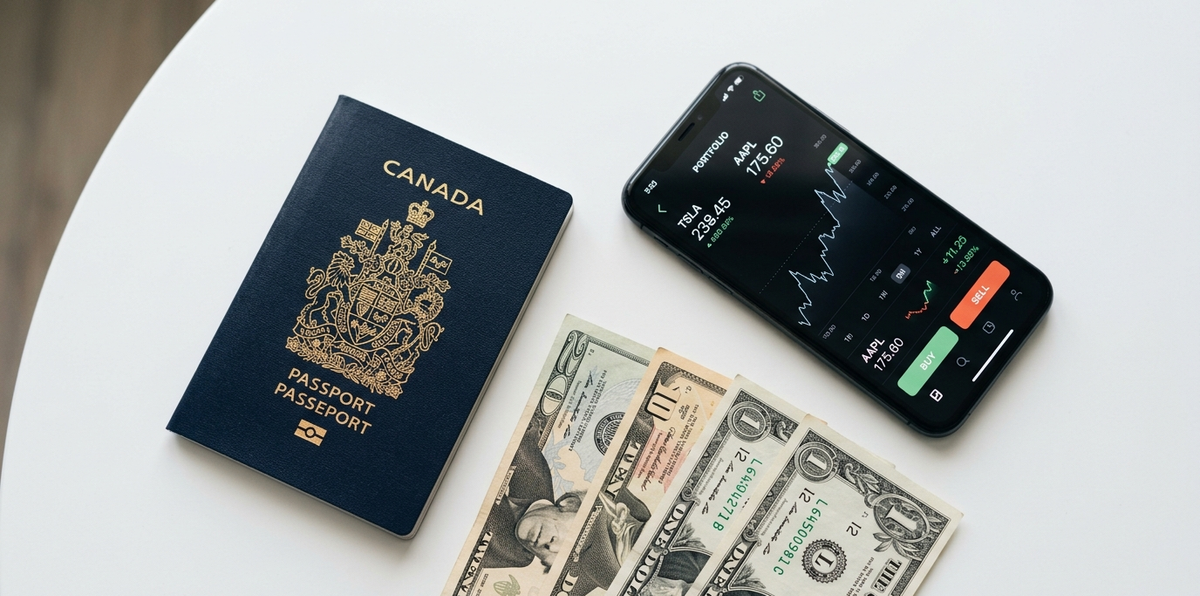
You can buy US stocks from Canada. Every major Canadian broker gives you access to the NYSE and NASDAQ, and the whole setup takes about 20 minutes. That's the short answer.
The longer answer is that most Canadians get it wrong on their first try. Not the buying part. Clicking "buy" is easy. It's everything around it. The account type, the currency conversion, the fees nobody mentions until you go looking for them. That's where the money quietly disappears.
I know because I got it wrong too. My first US stock purchase was through my bank's brokerage, in the wrong account type, paying a 2% currency conversion fee I didn't notice for months. I bought Tesla because it was exciting. Before that, I'd been chasing Canadian penny stocks during the weed legalization boom, absolutely convinced I was going to turn $2,000 into a down payment on a mansion. (I was not. The portfolio went up 400% in a week, I told everyone at work about it, and then it went down 95% while I held on hoping for a comeback. A formative experience. Almost a right of passage 😏. Ask around, there's some wild stories out there.)
Nobody teaches you this stuff. Not in school, not at the bank, and definitely not the guy at the party who just discovered options. Almost everything I've learned about investing came from getting it wrong, Googling at midnight, and slowly figuring out what actually matters. If I can save you a few of those midnight sessions, that's the point of this article.
Your account isn't what you think it is
This is where almost everyone gets tripped up, and it has nothing to do with US stocks specifically.
Most Canadians know they should have an RRSP or a TFSA. But knowing the name and understanding what's actually inside are 2 very different things. I've talked to people who opened an RRSP at their bank, watched it grow at 2% a year, and genuinely believed that's just what RRSPs do. Like the letters R-R-S-P carry some kind of magic growth spell. They didn't realize their money was sitting in a high-interest savings account (barely keeping up with inflation) or a managed mutual fund quietly charging a 2% MER to do the growing for them. Slowly. Expensively.
Here's what nobody explains clearly enough. An RRSP isn't an investment. A TFSA isn't an investment. They're containers. Shelves. What you put on the shelf is up to you. And what you're allowed to put on it depends entirely on where you opened the account and what type it is.
The 3 versions of your registered account
When you walk into a bank and say "I'd like to open a TFSA," you could walk out with 1 of 3 very different things.
The first is basically a savings account with a tax-free label on it. Your money sits in cash earning 1% to 3%. It's safe. It's also barely beating inflation, and you didn't open a TFSA to earn what your chequing account pays.
The second is a managed account. The bank puts your money into mutual funds, picks the investments for you, and charges 1% to 2.5% per year in management fees. You don't make individual decisions. This is fine for people who genuinely don't want to think about it. But you can't buy US stocks in a managed account. You own whatever the fund holds, and you don't get a say.
The third is a self-directed account. This is the one you need. A self-directed TFSA or RRSP lets you pick your own investments. Individual stocks, ETFs, bonds, GICs. You decide what goes in. This is the only version that lets you buy US stocks directly.
If your RRSP is at TD, RBC or Scotiabank and you've never placed a trade yourself, you probably don't have a self-directed account. That's not a problem. You can open one. But you need to know the difference exists, because nothing else in this article works without it.
Open a self-directed brokerage account
To buy US stocks from Canada, you need a self-directed account at a brokerage with access to US exchanges. Most Canadian brokerages offer this.
The main options are Questrade, Wealthsimple, Interactive Brokers (IBKR), and National Bank Direct Brokerage (NBDB). Each bank also has its own discount brokerage (TD Direct Investing, RBC Direct Investing, BMO InvestorLine, etc.), but they tend to charge higher commissions and wider FX spreads than the independent platforms.
I'd point most beginners toward Questrade or Wealthsimple. Both let you open a self-directed TFSA, RRSP, or non-registered account in a few minutes. Questrade is commission-free on ETF purchases. Wealthsimple is commission-free on everything. Both offer fractional shares, so you don't need $500 to buy a single share of something.
If you're already thinking about FX costs and you don't mind a steeper learning curve, IBKR is the cheapest platform for Canadians who trade US stocks regularly. But it's not where I'd start. IBKR's interface feels like it was designed by engineers who assumed all their users were also engineers.
One thing to know. Robinhood, Schwab, and Fidelity are US-only. You can't open an account with them as a Canadian resident. Every "how to invest" article written for Americans recommends these platforms. That advice doesn't apply here, and it's one of the most common dead ends Canadians hit when they start Googling.
Pick the right account type
You've got a self-directed brokerage account. Now you need to decide which account type to hold your US stocks in. This matters more than most people realize, and it's the kind of thing you only learn from someone who's already figured it out the hard way.
The TFSA is the simplest. Gains and withdrawals are completely tax-free in Canada. But there's a catch for US stocks that almost nobody mentions when you sign up. The US government charges a 15% withholding tax on dividends paid to your TFSA. The IRS doesn't recognize it as a retirement account, so they take their cut before the money reaches you. If you're holding US dividend stocks, that's 15% of every payment gone.
The RRSP gets a special exemption under the Canada-US tax treaty. US dividends paid into your RRSP aren't subject to that 15% withholding at all. If you're buying US stocks that pay dividends, the RRSP saves you real money every year.
A non-registered (taxable) account doesn't get the treaty exemption either, but you can claim the 15% withholding back as a foreign tax credit on your Canadian tax return. The money isn't lost. It's just more paperwork.
The short version. Growth stocks with no dividends can go in the TFSA. US dividend payers do better in the RRSP. I wrote a full breakdown of RRSP vs TFSA for US investing that goes deeper on the math if you want to see what the withholding tax actually costs at different portfolio sizes.
The part nobody tells you about
You've got your account. You know which type to use. You're ready to buy Apple, Tesla, VOO or whatever caught your eye. There's one more thing between you and that purchase, and it's quietly the most expensive part of the whole process.
You have Canadian dollars. US stocks cost US dollars. Someone has to convert your money.
Most Canadian brokers charge a 1.5% to 2.5% spread on that conversion. On a $10,000 CAD purchase, that's $150 to $250 gone before you've bought a single share. The broker doesn't charge you a visible fee. They just give you a slightly worse exchange rate than the real one. You'd never notice unless you went looking.
On $50,000, that's $750 to $1,250. On $100,000, you're handing over $1,500 to $2,500. These aren't commissions. They're not listed anywhere as fees. They're baked into the exchange rate, and most people never think to question it. I certainly didn't the first time around.
There's a workaround called Norbert's Gambit that cuts this cost to almost nothing. You buy an interlisted security in CAD, journal it to the US side of your account, and sell it in USD. Total cost is usually $10 to $20 in trading commissions instead of hundreds or thousands in FX markup. I wrote a step-by-step walkthrough of Norbert's Gambit that covers the process on every major Canadian broker.
If you're converting less than $1,000, the FX spread probably isn't worth stressing over. Over $5,000, it starts to sting. Over $10,000, Norbert's Gambit pays for itself many times over.
Place the trade
With your account open, funded, and currency sorted, buying a US stock is genuinely the easy part.
Search for the ticker symbol. AAPL for Apple, AMZN for Amazon, TSLA for Tesla, NVDA for Nvidia. Make sure you're looking at the US-listed version on the NYSE or NASDAQ, not a Canadian-listed equivalent on the TSX. Those have different tickers, different trading volumes, and sometimes different prices because of the currency.
Choose your order type. A market order buys at whatever the current price is. A limit order lets you set the maximum you're willing to pay. For established stocks during market hours, a market order is fine. If you're buying something volatile or trading outside regular hours, use a limit order so you don't get a surprise fill price. I personally do all my orders as a limit order, even if it's at the market price, I just like to know the exact price I'll pay and not more.
Hit buy. Your broker handles the settlement and the stock shows up in your account. The whole thing that felt intimidating before you did it the first time takes about 30 seconds once you know where the buttons are.
You also don't need to buy whole shares anymore. Both Questrade and Wealthsimple offer fractional shares, so you can put $100 into Amazon instead of needing $200+ for a full share. This makes regular contributions much more practical when you're starting out.
What about Canadian-listed ETFs?
You'll see a lot of advice telling Canadians to just buy a Canadian-listed ETF like VFV or ZSP instead of buying US stocks directly. These track the S&P 500, trade in CAD on the TSX, and skip the whole currency conversion step. That's fine advice for some people. But if you're reading an article called "how to buy US stocks in Canada," I'm guessing you want to actually buy US stocks.
Maybe you want Nvidia because you've been watching the AI run. Maybe you want to own Amazon or Costco or Berkshire directly instead of through a fund. Maybe you watched GameStop happen and thought "I want to be in that market, not watching it from the outside through a wrapper." That's the whole point of going direct. You get access to every stock on the NYSE and NASDAQ, not just what a fund manager decided to package for you.
Most Canadian-listed ETFs are wrappers. They hold the US-listed version inside them and pass the costs through, including a management fee and internal currency conversion. I covered the full comparison of Canadian S&P 500 ETFs if you're curious about where the hidden costs sit. For smaller portfolios or people who genuinely want a set-it-and-forget-it approach, they're a reasonable starting point. But this site exists because a lot of Canadians want to go further than that.
The bottom line
Buying US stocks from Canada takes about 20 minutes. Open a self-directed brokerage account, pick the right account type, convert your currency without getting gouged, and place the trade.
The mechanics are simple. The part that actually matters is everything you set up before you click "buy." Which account protects you from withholding tax. How you handle the currency conversion. Whether you understand what your broker is quietly charging you on the exchange rate. Get those right and you'll save yourself hundreds (or thousands) over time that most people hand to their broker without ever knowing.
Most people overcomplicate this or they never start because it feels like there's some secret step they're missing. There isn't. The whole process is what you just read. The difference between doing it well and doing it expensively comes down to 3 decisions you make before you ever place a trade. Self-directed account. Right account type. Smart currency conversion. Everything else is just clicking buttons.