Interactive Brokers vs Questrade 2026: Which Is Better for Canadians?
I use IBKR as my main broker for US markets. But Questrade is the better choice for a lot of Canadians. The right answer depends on how you invest, what you trade, and how much currency you're converting.

Interactive Brokers (IBKR) wins on currency conversion, margin rates, and access to things like futures and prediction markets. Questrade wins on commissions, simplicity, and account coverage. If you're buying US stocks from Canada, both will get the job done. But they don't feel the same at all, and they're not built for the same investor.
I use IBKR as my main broker for US markets. I run a TFSA and a cash margin account there. It's where I convert currency, where I trade, and where I park USD between positions. But I'm not going to pretend that makes it the right call for everyone.
The real cost of converting currency
IBKR charges about 0.002% to convert CAD to USD (minimum $2). Questrade's default is 1.5%. On a $50,000 conversion, that's $2 vs $750. This is the single biggest cost difference between these 2 brokers.
IBKR aggregates quotes from 17 of the world's largest FX dealers and passes through interbank rates with no markup. You're getting the same rates the big banks trade at, minus a tiny commission. Converting CAD to USD takes about 30 seconds. Place the trade, and the USD is available in your account for trading right away. (Formal settlement is T+2, the standard for spot FX, but you don't need to wait to use it.)
I've done it dozens of times and it still feels like a cheat code compared to every other option.
Questrade's default conversion costs 1.5%. On that same $50,000, you're paying about $750. That's not a rounding error. That's a vacation.
You can dodge most of that cost on Questrade by running Norbert's Gambit. Buy DLR.TO, journal it to DLR.U.TO, sell the USD side. Total cost drops to roughly 0.2%, or about $100 on $50K. But it takes 3 to 5 business days and involves a few manual steps. It works. It's just not instant, and you need to know it exists.
Here's the math at 3 portfolio sizes.
$25,000 conversion IBKR: ~$2 (minimum fee) Questrade (default): ~$375 Questrade (Norbert's Gambit): ~$50
$50,000 conversion IBKR: ~$2 Questrade (default): ~$750 Questrade (Norbert's Gambit): ~$100
$100,000 conversion IBKR: ~$2 Questrade (default): ~$1,500 Questrade (Norbert's Gambit): ~$200
If you're converting currency once and holding USD forever, the Norbert's Gambit route on Questrade is fine. If you're converting regularly or in larger amounts, IBKR saves you real money every single time.
Commissions and trading fees
Questrade eliminated commissions on stocks and ETFs in February 2025. Canadian-listed, US-listed, full shares, fractional shares. All $0. That's a big deal, and a lot of comparison articles haven't caught up to it yet.
IBKR still charges commissions. For Canadian stocks, it's about $0.01 per share with a $1 minimum. US stocks follow a tiered structure based on volume. Not expensive, but not zero.
For options, the gap is tighter. IBKR charges around $0.75 per contract on their tiered plan, scaling down with volume. Questrade charges $0.99 per contract with volume-based rebates. Both are reasonable for retail investors. If you're trading a few contracts a month, the difference is a rounding error.
On pure commissions, Questrade wins. That's a sentence I wouldn't have written 2 years ago.
Margin rates
IBKR Pro margin rates for Canadians sit around 4.14% to 5.14%, depending on your balance. Questrade doesn't prominently publish their margin rates, but they're generally higher, likely in the 6% to 8% range based on what other Canadian brokers charge at similar tiers.
On a $50,000 margin balance, that's the difference between paying roughly $2,500 a year at IBKR and $3,500+ at Questrade. On $100,000, the gap widens to over $2,000 annually.
If you don't use margin, this section doesn't apply to you. Skip it. But if you do, or if you plan to, IBKR's rates are meaningfully lower. Not marginally 🫣 (Sorry).
What they both do fine
Before I get into the differences, the basics are covered on both platforms. Short selling (margin accounts only), covered calls, multi-leg options (spreads, iron condors), fractional shares, and dividend reinvestment all work on either one. If you're buying and holding S&P 500 ETFs, selling covered calls, or building a long-term portfolio, neither broker will hold you back. The gap shows up when you want more than the basics.
What IBKR offers that Questrade can't
Three things Questrade simply doesn't have.
Futures
IBKR gives you full access to futures markets. US futures run about $2.25 per contract in commissions, Canadian futures about $2.00 CAD. You can trade S&P 500 futures, crude oil, gold, treasuries, the whole range. Margin on futures works differently than stocks. You're posting collateral, not borrowing at an interest rate. A single Micro E-mini S&P 500 contract requires roughly $1,200 USD to hold. Questrade doesn't offer futures. At all. If futures are part of your strategy, this comparison is already over.
Prediction markets
IBKR launched ForecastEx in Canada in 2025, making it the first CIRO dealer to offer forecast contracts here. These are binary contracts on real-world events. Will the Fed cut rates at the next meeting? Will nonfarm payrolls beat expectations? Will Bitcoin close above $80,000? You buy a contract between $0.02 and $0.99, and it settles at $0 or $1. Think of it as putting your macro takes where your money is.
Canadian accounts are limited to economic, financial, and climate contracts (no politics, no sports). But for anyone who's ever yelled at a CPI print, this is your chance to get paid for being right. You also earn 3.14% APY on the value of your positions while you hold them. No other broker available to Canadians offers anything like this yet.
Interest on uninvested cash
IBKR pays you to hold cash in your account. On USD balances above $10,000, the rate is around 3.14%. On CAD above $13,000, about 1.44%. The full rates kick in at $100,000+ in account value. Smaller accounts still earn interest, just at lower rates.
Questrade pays nothing on idle cash. Zero. If you keep any meaningful amount of cash between trades, IBKR is quietly paying you while Questrade isn't.
None of these are must-haves for every investor. But if you want even one of them, IBKR is your only option.
Platform and data
IBKR gives you 5 ways to trade. Trader Workstation (TWS) is the professional desktop app, packed with tools. It's not winning any design awards but I love it. It's highly functional and does everything you could want it to do and more. IBKR Desktop is the newer, cleaner client that's a lot more approachable. Then there's Client Portal (web), IBKR Mobile, and IB Gateway for API and automated trading.
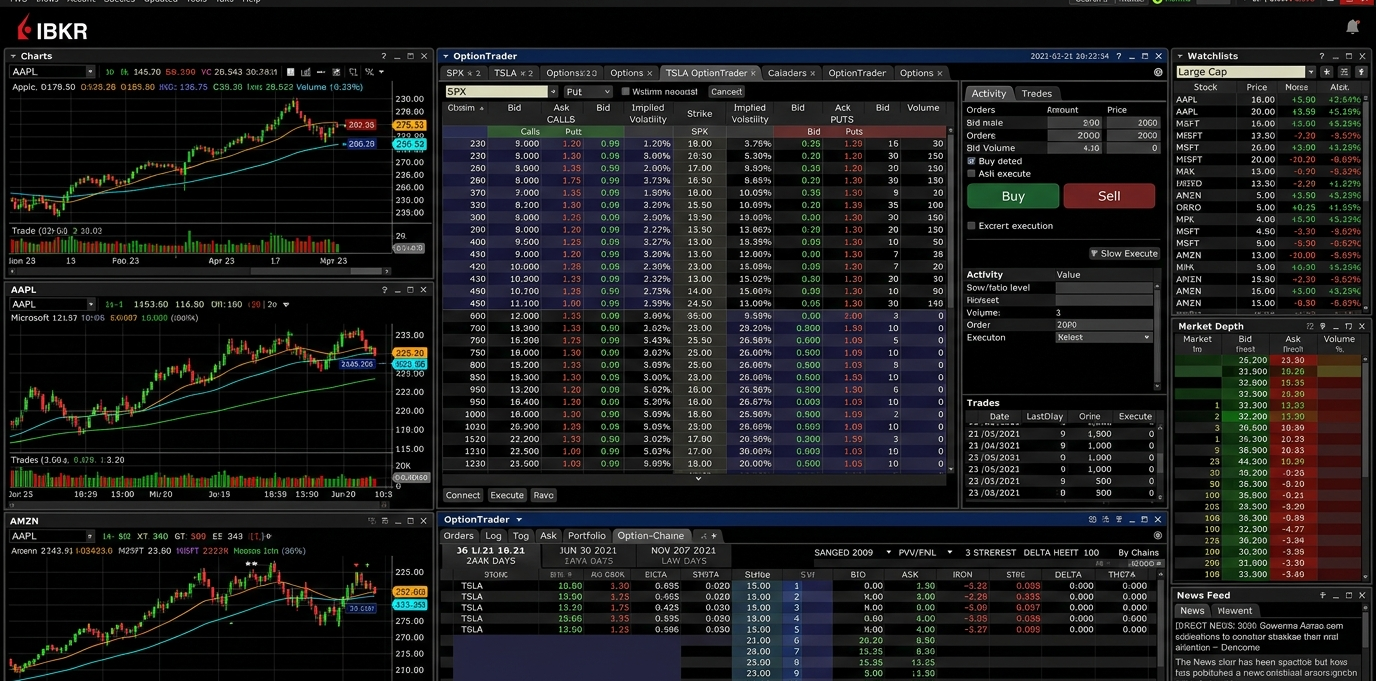
That's a lot of surface area. Most people will pick one and stick with it, but the option to graduate from Client Portal to TWS without switching brokers is worth something. (Canadian regulators block algo orders on Canadian-listed securities through the API, but US-listed trades are fine.)
Questrade has Edge Desktop, Edge Web, and QuestMobile. The Edge platforms are solid, modern, and easier to pick up than anything IBKR offers. If you value a clean interface and don't need professional-grade tools, Questrade feels more polished the moment you log in.
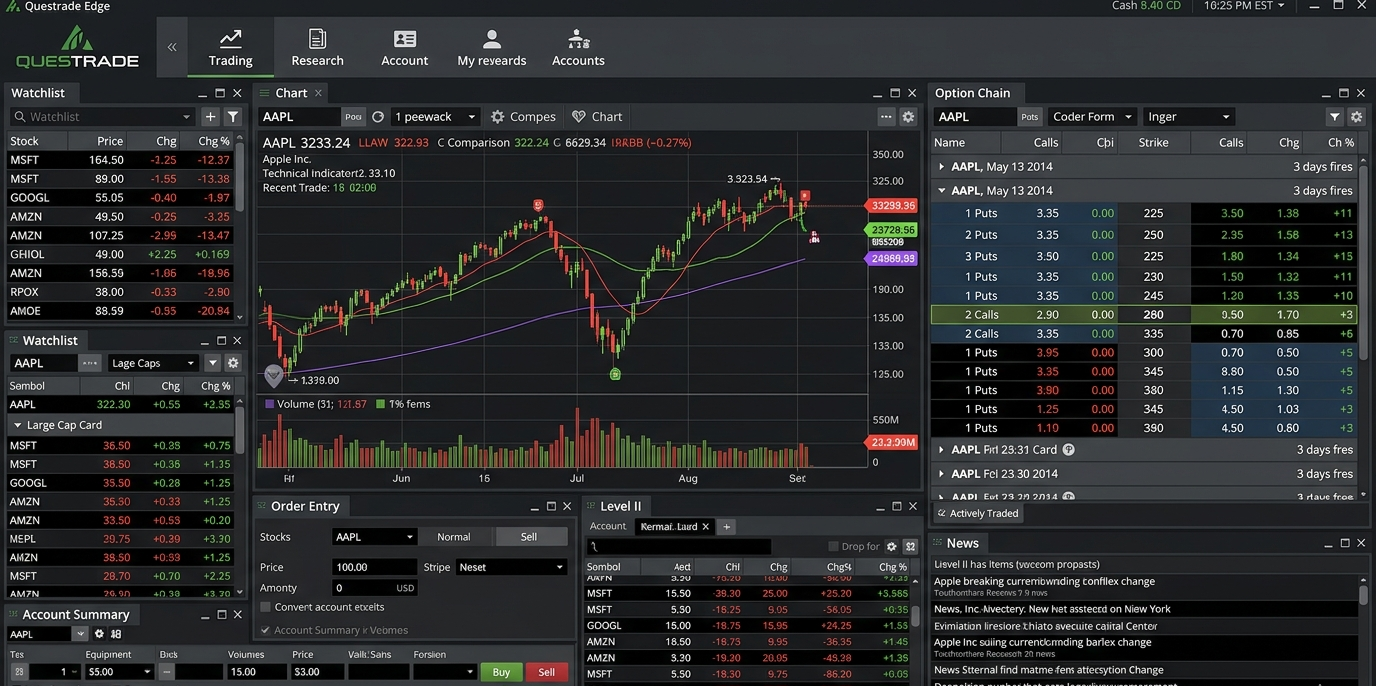
For market data, IBKR includes free real-time Level 1 streaming on US stocks and ETFs. You pay for Level 2 and Canadian data, but the baseline is covered. Questrade charges $9.95 CAD per month for basic real-time data, and $44.95 USD per month for Level 2 across US and Canadian exchanges. That's over $500 USD a year if you want the full picture.
IBKR also offers near-24/6 trading on US securities. Questrade gives you 4am to 8pm ET, with very limited after-hours on Canadian securities. Not a dealbreaker for most people, but if you trade around earnings or overnight moves, IBKR gives you a lot more runway.
One is Canadian, the other isn't
Questrade is a Canadian company. Founded in Toronto, headquartered in Toronto, staffed in Toronto. IBKR is a subsidiary of Interactive Brokers Group, headquartered in Greenwich, Connecticut. It operates here through Interactive Brokers Canada Inc.
For investor protection, the difference is minimal. Both are CIRO members. Both are covered by CIPF, which protects your accounts up to $1 million per category if the firm goes insolvent. Your money is safe either way.
Where it does matter is account types. Questrade offers every registered account available to Canadians. RRSPs, TFSAs, FHSAs, RESPs, RRIFs, LIRAs, and non-registered. IBKR covers the core ones (RRSP, TFSA, FHSA, margin, non-registered) but doesn't offer RESPs, RRIFs, or LIRAs. If you need an education savings plan for your kids or you're rolling a pension into a LIRA, Questrade is your only option.
A few more things worth knowing. Questrade requires a $1,000 minimum deposit to start trading. IBKR has no minimum for cash accounts ($2,000 for margin). And if you ever want to leave Questrade, that costs $150 plus tax. IBKR charges $0 to transfer out. These aren't dealbreakers, but they're the kind of details you only find out after you've already signed up.
So which one should you use?
There's no single winner here. But there is a right answer for you, and it depends on how you invest.
You want zero commissions, a clean app, and every account type under one roof. You buy US stocks and ETFs, maybe sell some covered calls, and you don't want to think about your broker more than you have to. You might have an RESP for your kids or a LIRA from an old employer. Questrade is your broker. It's simpler, it's $0 to trade, and it covers every account type a Canadian might need.
You're an active US markets investor who cares about costs at scale. You convert meaningful amounts of CAD to USD. You use margin. You want futures, or prediction markets, or both. You care about getting paid on idle cash and you don't mind a steeper learning curve. IBKR is your broker. It's what I use, and the savings on FX and margin alone justify the switch for anyone operating at this level.
You're on Questrade and starting to feel the limits. Maybe you're converting enough currency that the 1.5% spread is costing you hundreds of dollars a year. Maybe you want to trade futures and can't. Maybe you've noticed your cash earns nothing while it sits between trades. That's the signal. Once the platform is costing you more than the friction of switching, it's time.
Both are good brokers. They're just built for different investors, and it's OK to outgrow one and move to the other.
Update (March 2026): Not sure Questrade is right for you either? I wrote a full Questrade vs Wealthsimple comparison here.